Understanding Health Anxiety and Hormonal Changes: A Guide to Regaining Control
- Saira Naomi
- Mar 26
- 6 min read


Whilst you were stuck in traffic on the school run, a thought popped into your head that you didn’t want, but couldn’t quite shake.
“What if the car suddenly caught on fire?”
Before you had time to process it, your brain started running through every possible scenario. You wondered how you would get out, how you would get the kids out, who you would call, and how you would explain what had happened. Almost as quickly, another thought followed, telling you how horrible that idea was, and by the time the traffic started moving again, you had quietly decided that tomorrow you would walk instead.
This exact situation might not match your experience, but the pattern often does.
An intrusive thought appears, your brain immediately interprets it as a threat, and you respond by changing your behaviour in order to feel safe. That response then teaches your brain that it was right to sound the alarm, and over time, something that was never actually dangerous begins to feel like it is.
Why this suddenly starts happening
One of the most confusing parts of health anxiety is how suddenly it can appear, especially if you have always seen yourself as quite rational or able to manage stress well. It can feel as though your mind has changed overnight, and that loss of familiarity is often what makes it so unsettling.
During perimenopause, fluctuations in oestrogen and progesterone affect far more than your cycle. These hormones play a key role in how your brain regulates mood, processes fear, and filters information, which means that when they shift, your tolerance for uncertainty and stress can shift with them.
As a result, thoughts that you might previously have dismissed can begin to stick, and your brain can become more alert to potential threats, even when there is no real danger present. This is often why health anxiety feels more intense during this stage of life, as your brain is quicker to latch onto thoughts and treat them as important.
Understanding the anxiety cycle
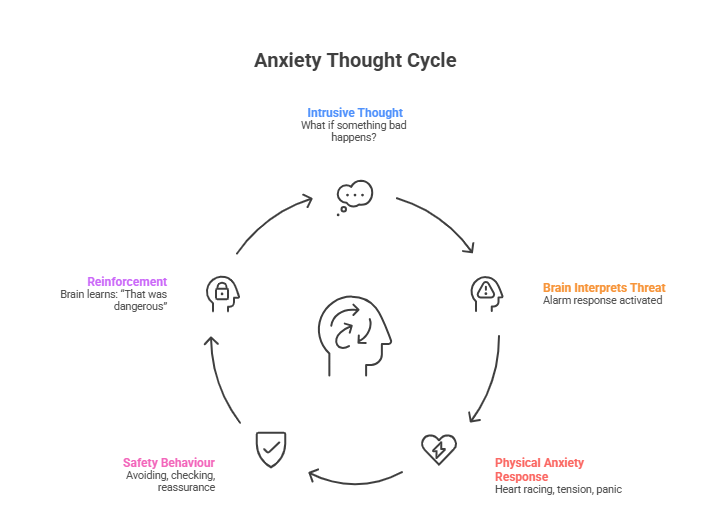
It can be helpful to think of anxiety as a cycle rather than a one-off reaction, because once you understand the pattern, it becomes much easier to see why it keeps repeating.
It usually begins with a thought, often something along the lines of “What if something is wrong?” or “What if something bad happens?”. That thought triggers a physical response in your body, such as a racing heart, tension, or a sense of panic. Naturally, you then try to reduce that feeling by doing something that helps you feel safe, such as avoiding the situation, checking symptoms, or seeking reassurance.
While this brings relief in the moment, it also teaches your brain that the situation was dangerous, because your behaviour suggests that it needed to be avoided. Your brain does not register the relief as “I coped”; instead, it learns “I escaped something unsafe”. Over time, this reinforces the anxiety and makes it more likely to return, often more quickly and more intensely.
What should happen instead

What often gets missed is that everyone has intrusive or strange thoughts.
We all have thoughts that feel uncomfortable, inappropriate, or completely out of character. The kind of thoughts that make you pause and think, “Where did that come from?” or “I would never actually do that.” Most people simply don’t talk about them, which is why it can feel like you are the only one experiencing it. In reality, you are not.
The difference is not in the thought itself, but in what happens next.
For most people, a thought comes in, they notice it, feel a bit uncomfortable, and then it passes. It might register as, “That was a strange thought” or “I didn’t like that,” and then their attention moves on. The thought is not given importance, and the cycle ends there.
However, when health anxiety is involved, the thought does not just pass through. Instead, it captures your full attention.
You analyse it, question it, try to understand it, or attempt to push it away. In doing so, you remain engaged with it for longer than intended, which signals to your brain that the thought is important or potentially threatening.
What can make this even stronger is the instinct to try to control or get rid of the thought completely. Although this feels like the right thing to do, the more you try to suppress a thought, the more your brain treats it as something that needs attention. In many ways, it is similar to repeatedly checking something for safety, which reinforces the idea that there might be danger in the first place. Over time, this is what keeps the cycle going.
Changing your response, not fighting your thoughts

Part of learning to manage anxiety is not about stopping thoughts from appearing, because that simply is not something we can control. Instead, it is about changing how you respond so your brain no longer treats the thought as a threat.
This is where cognitive reframing can be helpful. It involves learning to look at your thoughts in a more balanced and less threatening way, rather than automatically accepting them as fact.
For example, instead of immediately believing a thought such as “Something bad is going to happen”, you might begin to recognise it as “My brain is trying to protect me, but that does not mean I am actually in danger”.
This shift may feel small, but it changes your relationship with the thought and reduces the urgency attached to it.
There are practical ways to support this process, including noticing patterns in your thinking, gently questioning whether a thought is entirely true, and creating a more realistic alternative rather than an overly positive one. It can also help to reduce behaviours such as constant checking or avoidance, as these tend to reinforce the cycle rather than break it.
If you’re reading this and thinking “okay, but how do I actually do that in the moment?”, it can really help to have something practical to follow.
A simple CBT-based self-help worksheet can guide you through recognising the thought, stepping back from it, and responding in a more balanced way. It gives you a structure to follow when your brain feels loud, rather than trying to figure it out on the spot.
👉 You can download a helpful CBT thought record sheet here:
You don’t need to fill it in perfectly. Even just writing down the thought and gently questioning it can start to shift how your brain responds over time.
You don’t need to fill it in perfectly. Even just writing down the thought and gently questioning it can start to shift how your brain responds over time.
Where hormones fit into all of this
If this pattern has appeared during perimenopause, it is important to recognise that your brain is working with a different hormonal environment than it was before. This does not mean something is wrong, but it does mean your nervous system may be more sensitive, and your usual coping strategies may not feel as effective.
This is often why the thoughts feel “stickier” than they used to, and why it can feel harder to let them pass in the way they once did.
Understanding this can help remove some of the self-blame, because this is not simply about mindset or willpower. It is the result of hormonal changes, nervous system responses, and learned patterns working together.
Final thoughts
Health anxiety linked to hormonal changes can feel frightening, particularly when the thoughts feel unfamiliar or out of character. However, recognising the pattern is an important first step, because it allows you to see that there is a process behind what you are experiencing.
Once you understand how the cycle works, and how your response influences it, you can begin to change it gradually. This does not mean eliminating anxiety completely, but learning to respond in a way that no longer reinforces the fear.
The things that feel like they should protect you, such as avoiding situations or trying to control your thoughts, can often be the very things that keep the anxiety going. Once you understand that, it becomes possible to respond differently.
You are not losing control of your mind, and you are not imagining things. You are experiencing a shift that affects both your body and your brain, and with the right understanding and support, it is possible to feel more steady again.


Comments